Quick answer
The WhatsApp Business API bills in three layers: Meta's message fees, the Business Solution Provider's markup, and the tool subscription. Since 1 October 2026 Meta also charges for replies past 1,000 a month. A small business at 2,000 conversations a month pays Meta roughly $50 to $85, depending on how many replies each chat takes, about $60 to $115 once the BSP markup lands, plus $39 to $99 for the tool. All in, expect $100 to $200 a month.
- Three layers: Meta's message fees, the BSP markup, and the tool subscription on top.
- A mid-tier BSP arrangement adds 20 to 40 percent above Meta's raw cost.
- All in, a small business on the API usually pays $100 to $200 a month.
- Below about 1,000 conversations a month, a linked-device tool at $19 to $39 costs less.
Update, 1 October 2026. Meta's new rate card took effect today. Replies inside the 24-hour customer service window are now charged after a free 1,000 a month per business number, and every figure below is from the card effective 1 October 2026, retrieved the same day. Several tool prices have moved since this was first written; the three-layer structure and the decision at the end still hold. For current numbers see Wati pricing in 2026, Respond.io pricing in 2026, Interakt pricing in 2026 and AiSensy pricing in 2026.
If you've been quoted "WhatsApp Business API integration" by a tool, the actual cost is more complicated than the price tier on their pricing page. There are at least three layers, and one of them is paid directly to Meta — the tool only sees a slice.
Here's the honest breakdown for 2026, from the perspective of a small business trying to decide whether the API path is right for them.
What changed in WhatsApp API pricing on 1 October 2026?
Meta's new USD rate card took effect on 1 October 2026 (retrieved from Meta for Developers that day). Three things changed for a business on the official API:
- Service messages are now charged. A service message is any non-template reply you send inside the 24-hour customer service window. Each one costs the same as a utility message to that market, after a free allowance of 1,000 service messages per business phone number per month. Unused messages do not roll over, and group sends draw from the same allowance. Reactions stay free.
- Utility templates inside the window are charged. An order confirmation sent while the customer's window is open was free from 1 July 2025; it now costs the utility rate.
- Some rates moved. Marketing rose in Kuwait, Mexico, Morocco, Saudi Arabia, the UAE, Rest of Middle East and Rest of Asia Pacific. Utility and authentication rose in Kazakhstan, Kuwait, Morocco, Oman, Pakistan, Peru, South Africa and Ukraine, and fell in Bangladesh, Iraq, Nepal and Sri Lanka. Those nine smaller markets now have their own rates instead of a regional one. India, Brazil, Malaysia, Singapore, the UK and Indonesia are unchanged.
What stays free: messages customers send you, and anything inside a free entry point window, which a click-to-WhatsApp ad opens and Meta now says can last up to 7 days. Meta also warns that a business with no payment method on file will have service messages stopped once its free 1,000 are used.
Who gets paid when you use the WhatsApp Business API?
- Meta message fees: paid to WhatsApp/Meta, billed per delivered message by category and the customer's country
- BSP (Business Solution Provider) fees — paid to the company that hosts your API connection. Some BSPs charge a flat markup per conversation, others bake it into the tool fee
- Tool / platform fee — paid to whatever vendor you actually use (WATI, Twilio, Respond.io, etc.) for the UI + features
The tool's pricing page usually shows you (3). It often barely mentions (1) and (2), even though those can add up to more than (3) at volume.
Meta's per-message fees (current rates)
Since 1 July 2025 the WhatsApp Business Platform has charged per delivered message, not per 24-hour conversation; Meta's old conversation-based pricing page is marked deprecated. Since 1 October 2026 four categories are billed: marketing, utility, authentication and service.
What is not billed matters just as much:
- The first 1,000 service messages each month. Replies inside the 24-hour customer service window are free up to 1,000 per business phone number per month, then charged at the utility rate. The allowance resets monthly and does not roll over.
- Anything inside a free entry point window. A click-to-WhatsApp ad opens one when you reply, and Meta says it can last up to 7 days. Any marketing, utility, authentication or service message sent inside it is free.
Rates depend on the recipient's country, not yours. From Meta's USD rate card effective 1 October 2026, retrieved on 1 October 2026:
| Market | Marketing | Utility, authentication and service |
|---|---|---|
| India | $0.0118 | $0.0014 |
| Brazil | $0.0625 | $0.0068 |
| Mexico | $0.0397 | $0.0085 |
| Indonesia | $0.0411 | $0.0250 |
| Malaysia | $0.0860 | $0.0140 |
| UAE | $0.0576 | $0.0157 |
| Singapore | $0.0732 | $0.0160 |
| United Kingdom | $0.0635 | $0.0220 |
| Morocco | $0.0414 | $0.0230 |
| Rest of Africa | $0.0225 | $0.0040 |
Meta publishes the same card in sixteen billing currencies; the currency follows your billing account, not the customer's country. Utility and authentication carry volume discounts of up to 25 percent at scale. Marketing and service do not.
So a Malaysian shop sending marketing templates pays about $0.086 per delivered marketing message to Meta, before any BSP or tool fee, and $0.014 for each reply to a customer once the month's free 1,000 are used up.
What this looks like at SMB volume
Meta now bills replies as well as templates, so these examples count replies. Assume one reply per inbound conversation; the second example shows what longer threads do. Rates are Malaysia's on the 1 October 2026 card.
Say you're a Malaysian cafe doing 200 customer conversations per month via WhatsApp Business API.
- 150 are customers writing in and being answered inside the 24-hour window: 150 service replies, all inside the free 1,000: $0
- 30 are utility templates sent after the window closed (order ready): 30 × $0.0140 = $0.42
- 20 are marketing templates (Friday's specials): 20 × $0.0860 = $1.72
Total to Meta: $2.14/month, the same as before 1 October. Even at three replies per chat, 450 replies, the cafe stays inside the free allowance.
Now scale up: same business at 2,000 conversations/month (a busy florist or busy restaurant), with a higher marketing mix:
- 1,200 inbound answered inside the window: 1,200 service replies, the first 1,000 free: 200 × $0.0140 = $2.80
- 300 utility templates outside the window: 300 × $0.0140 = $4.20
- 500 marketing templates: 500 × $0.0860 = $43.00
Total to Meta: $50.00/month, up from $47.20 before 1 October. Plus BSP markup. Plus tool fee. Marketing templates are still 86 percent of that bill.
Threads rarely end after one reply, though. At three replies per inbound chat the florist sends 3,600 service messages, 2,600 of them charged: $36.40, which takes Meta's total to $83.60. Order confirmations sent while a customer's window is open now cost the utility rate too, so reply volume is the second meter to watch.
BSP markups
Most BSPs charge either a flat markup per conversation or a higher subscription tier. Some examples (publicly listed 2026 pricing):
- WATI: ~10-20% markup baked into tier pricing + a per-conversation overage fee on higher volumes
- Twilio: flat-rate per-message API fee (no UI included)
- 360dialog: ~€49/month base, then per-conversation pass-through
- Gupshup: subscription tiers with conversation allowances
A typical mid-tier BSP arrangement adds 20 to 40 percent on top of Meta's raw cost. So that $50.00 Meta bill becomes roughly $60 to $70, or $100 to $117 at three replies per chat, before you have paid for the tool's own interface and features.
The tool fee on top
Then there's the tool subscription:
- WATI: $39/month entry tier (limited features), $99/month standard
- Respond.io: $79/month team tier (5 users)
- Trengo: €59/seat/month
- Intercom (with Fin AI): $29-$132/seat/month plus per-resolution AI fees
So for our busy Malaysian florist on WATI’s $99 tier: $99 for the tool plus about $60 to $70 for Meta and the BSP markup, roughly $160 to $170 a month all in, and about $199 to $216 if each chat takes three replies.
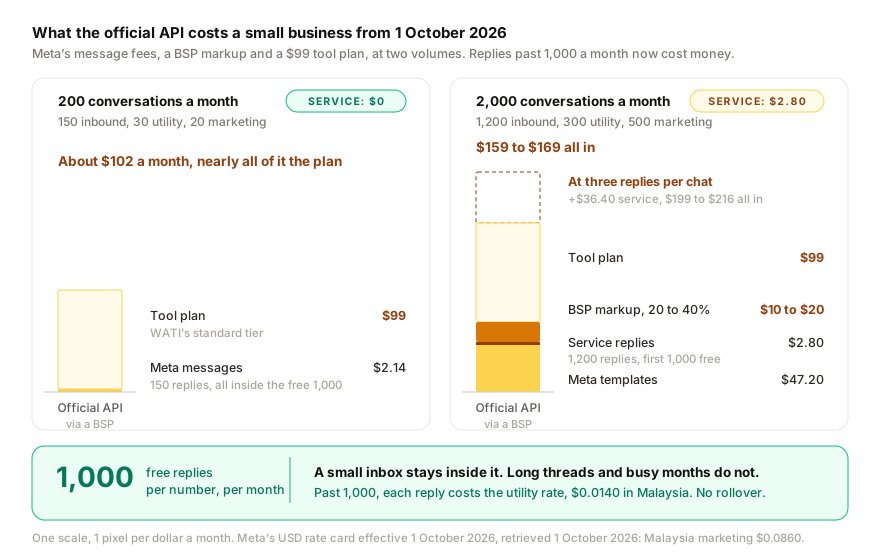
That's the actual all-in cost of "WhatsApp Business API + a tool" for a single small business.
What do the WhatsApp Business API fees buy you?
What the official Business API gives you that no other path can:
- Verified Business badge in WhatsApp (green checkmark) — only available via the API
- Broadcast templates for marketing to opted-in users at scale (thousands+ per send)
- Multiple agents on one number with proper routing + handover
- Reliable delivery guarantees with Meta's SLA
- Compliance for industries that need it (banking, healthcare, regulated sales)
If you genuinely need any of those — especially broadcast templates or multi-agent routing — the API path is the right path. Pay the fee, get the capability.
What you DON'T need it for
Most SMBs don't actually need the Business API. They need:
- Answer inbound customer questions automatically — doesn't need API
- Capture leads from WhatsApp enquiries — doesn't need API
- Multi-language customer service — doesn't need API
- Handle voice notes + photos — doesn't need API
- Stay available outside business hours — doesn't need API
All of those can be done by pairing a tool as a linked device to your existing WhatsApp Business number — same way WhatsApp Web does. No Meta application, no per-conversation fees, no BSP markup.
That's what Replai does. Flat $19/month, AI included, no per-conversation fees. The trade-off is you don't get the green Verified badge or broadcast templates. For most SMBs, that's a perfectly reasonable trade.
How to decide
Ask yourself:
- Do you need to send marketing broadcasts to thousands of opted-in users? → API path
- Do you need the green Verified badge for trust signaling? → API path
- Do you need multiple agents on one number with formal routing? → API path
- Do you just need to answer inbound customer questions better? → Linked-device tool (Replai or similar). Save $100-180/month.
If the answer to questions 1-3 is no, the API path is overpaying for capability you won't use.
The honest summary
The WhatsApp Business API is genuinely useful at the right scale, usually 1,000 or more conversations a month with a meaningful marketing-broadcast component. Below that, the all-in cost of roughly $100 to $170 a month is often higher than what a simpler linked-device tool does for $19 to $39.
Match the tool to the use case, not the other way round.
Related
- WhatsApp Business API vs WhatsApp Business App
- WhatsApp Coexistence: can the app and the Cloud API share one number?
- What to do if WhatsApp bans your business number
- Replai vs Wati
- Replai vs Respond.io
- What counts as a conversation in WhatsApp AI pricing?
- WhatsApp auto-reply for Malaysian small businesses: the 2026 guide
Frequently asked questions
How much does the WhatsApp Business API cost per message in 2026?
- Meta charges per message since July 2025, with a rate card per country and category. Examples from Meta's card: marketing messages cost $0.0118 in India, $0.0411 in Indonesia, $0.0625 in Brazil and $0.0860 in Malaysia; utility messages are a fraction of that. Since 1 October 2026 replies inside the 24-hour customer service window are charged too, at the utility rate, after the first 1,000 a month per business number.
What changed in WhatsApp API pricing on 1 October 2026?
- Meta started charging for service messages, the replies a business sends inside the 24-hour customer service window, at the same rate as utility in each market, after a free 1,000 per business phone number each month with no rollover. Utility templates sent inside that window stopped being free too. Marketing rates rose in markets including Mexico, the UAE and Saudi Arabia, nine markets such as Morocco and Kuwait got their own rates, and India, Brazil, Malaysia, Singapore, the UK and Indonesia were unchanged.
What are the three cost layers of the WhatsApp Business API?
- Meta's per-message fees, the Business Solution Provider's markup on those fees, and the provider's own software subscription. Tools like Wati, Respond.io, Interakt and AiSensy sit in the second and third layers; some mark Meta's rates up by 10 to 39 percent, others pass them through at cost.
Can a small business avoid WhatsApp API fees entirely?
- Yes, by not using the API. A chatbot that pairs to your existing number as a linked device, the way WhatsApp Web does, has no Meta fees at all. Replai pairs to the WhatsApp number you already have as a linked device, so there is no Meta application and no per-message fee. Plans are $19, $49 or $99 a month with the AI included, and a 7-day trial needs no card. The trade-off is that it is unofficial and unsuited to bulk marketing.
Is the WhatsApp Business API worth it for a small business?
- It is worth it if you send thousands of outbound messages a month, need the green verified badge, or must have a sanctioned channel. For a business whose problem is answering inbound questions on one or a few numbers, the API's fees and approval process usually outweigh the benefit.
Sources
- WhatsApp Business Platform pricing, Meta for Developers, 2026-10-01
- WhatsApp Business app, Meta, 2026-09-08
Keep reading
See it answer your own customers.
Pair your number, paste in what you know, and message it from another phone. Ten minutes, no card.