Quick answer
On Replai a conversation is up to five bot replies in one thread with one customer, so a three-reply thread is one unit and a twelve-reply thread is three. Your own replies and the customer's messages never count. Meta counts differently: since 1 July 2025 the official API bills per delivered template message, by category and country, while replies inside the 24-hour customer service window stay free.
- One conversation is up to five bot replies in a single customer thread.
- Caps per cycle: 120 on Starter, 300 on Growth, 600 on Pro.
- At 80 percent of the cap you get an email; at 100 percent the bot pauses.
- A Conversation Pack adds 100 conversations for $9 on Starter, $8 on Growth or $7 on Pro, and rolls into the next cycle until spent, for 12 months.
"Conversation" is the unit almost every WhatsApp tool bills on, and almost every tool means something different by it. Meta used to mean a 24-hour window and now bills per delivered template. Some tools mean a contact. Some mean a message. The word on a pricing page tells you nothing until you know what it counts.
This post explains the two definitions you'll actually meet, shows what each plan cap looks like in real threads, and gives you a way to size a plan from the volume you already have.
Meta's definition: per delivered template, inside a 24-hour window
That window changed shape in 2025. Since 1 July 2025 the WhatsApp Business Platform bills per delivered template message rather than per 24-hour conversation, across marketing, utility and authentication, while non-template replies inside the 24-hour customer service window stay free and a click-to-WhatsApp ad opens a free entry point window of 72 hours (Meta for Developers, WhatsApp Business Platform pricing). The window still decides what is free; it no longer decides what is counted.
The 24-hour window still shapes everything on the official API, it just no longer decides the bill. The window opens when a customer messages you; replies you send inside it are free, and anything outside it has to be a template, which is what you are charged for, by category (marketing, utility, authentication) and by the customer's country. Until 1 July 2025 the same window was itself the billed unit, which is the pricing most older articles describe.
Either way it is paid to Meta on top of whatever the tool charges. The rate card is in What WhatsApp Business API actually costs in 2026.
Replai's definition: up to 5 bot replies in a thread
Replai pairs to your existing number as a linked device rather than using the API, so there's no Meta window to bill against. The unit is based on the work the assistant does instead:
One conversation = up to 5 bot replies in one thread with one customer.
- A thread where the bot replies 3 times is 1 unit.
- A thread where the bot replies 5 times is 1 unit.
- A thread where the bot replies 12 times is 3 units (5 + 5 + 2).
- Replies you send yourself after taking over the thread don't count. Neither do the customer's own messages.
The clock isn't part of it. What's counted is how many times the assistant replied in the thread, however fast or slow the exchange was.
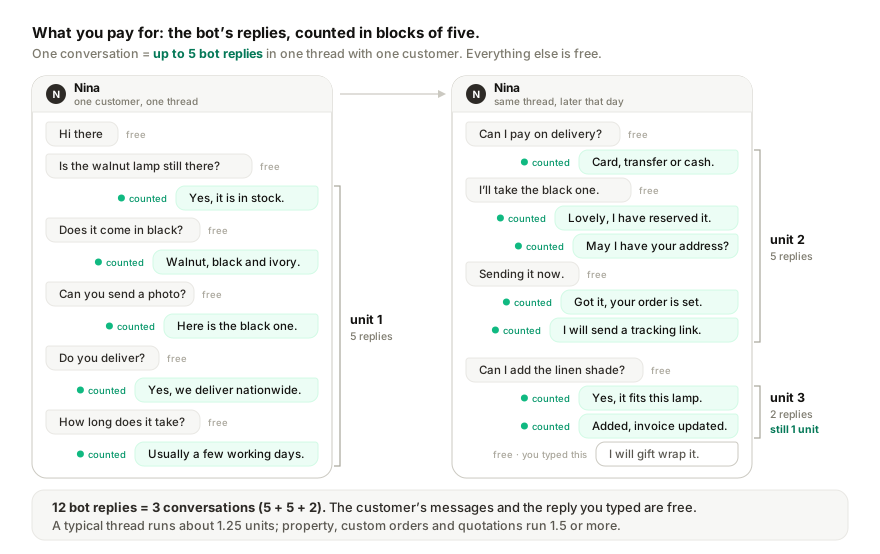
What the caps look like in real threads
Each plan has a cap of conversation units per billing cycle. The AI cost is included in every plan, so there's no API key and no token bill on top.
| Plan | Price | Units per cycle | Threads if all are short | Threads if 1 in 4 runs long |
|---|---|---|---|---|
| Trial (7 days) | Free, no card | 10 | 10 | 8 |
| Starter | $19/mo | 120 | 120 | 96 |
| Growth | $49/mo | 300 | 300 | 240 |
| Pro | $99/mo | 600 | 600 | 480 |
| Managed | Custom | Uncapped | Uncapped | Uncapped |
"Short" means five bot replies or fewer, which is where most enquiries land. The right-hand column assumes one thread in four needs a second block of replies, which works out at 1.25 units per thread and is a fair planning number for a shop, a cafe or a clinic. A business that does a lot of back-and-forth over WhatsApp (property, custom orders, quotations) should plan on 1.5 or more.
On Growth the 300 units are shared across up to 3 numbers; Pro covers up to 5 numbers with 600 units. A business with a sales number and a support number pools them rather than splitting a cap in two.
What happens at 80% and 100%
- At 80% of the cap you get an email. That's the moment to decide whether to top up or move plan before anything stops.
- At 100% you get a second email and the assistant stops replying until the cycle resets or you buy a top-up. Inbound messages are still received, stored and visible in the dashboard, so nothing is lost. Your own WhatsApp keeps working as normal, so you can answer by hand in the meantime; customers just aren't getting an automatic reply until you act.
Can you top up conversations mid-cycle?
A Conversation Pack adds 100 conversations, priced by the plan you are on: $9 on Starter, $8 on Growth and $7 on Pro, so the rate falls as you grow. You can buy one at any time. Your plan’s own allowance is always spent first, so the pack is only touched once you actually go over. Whatever is left of it rolls into the next cycle and keeps rolling until it is spent, for up to 12 months from the day you bought it. Buy several and they stack into one balance, with the soonest-expiring spent first.
Top-ups are priced so that a month that runs hot doesn't force a plan change. If you find yourself buying them every cycle, moving up is usually about the features rather than the maths: Growth adds outbound campaigns, voice notes and image handling, and room for up to 3 numbers.
Yearly plans still refill monthly
Yearly billing (Starter $209, Growth $539, Pro $1,089, twelve months for the price of eleven) doesn't turn the cap into an annual pool. You get the same units each month, refilled monthly; the yearly price covers twelve cycles up front. If you're going yearly, size the plan on your busiest month rather than your average one, because a quiet month doesn't bank units for a busy Raya season.
Sizing a plan from your inbox
You don't need to guess. Count from what you already have:
- Count the distinct customers who messaged you last month. Scroll the chat list, or export if you must.
- Multiply by 1.25 for a typical mix, or 1.5 if your conversations tend to run long.
- Add 20% headroom so a good month doesn't hit the cap.
- Pick the smallest plan whose units cover that number.
Two worked examples. A tuition centre gets 180 parent enquiries a month: 180 × 1.25 = 225, plus 20% is 270, so Growth's 300 covers it. A florist gets 70 enquiries a month: 70 × 1.25 = 88, plus 20% is 105, which fits inside Starter's 120, with a top-up in reserve for Valentine's week.
How do you make conversation units last longer?
The cap counts bot replies, so anything that shortens threads stretches it:
- A complete knowledge base. Most extra replies are the assistant asking for something it should already know, or telling the customer it will check with the team. If prices, hours, delivery areas, policies and the answers to your twenty most common questions are in there, a thread that would have taken four replies takes one. The free WhatsApp FAQ generator is a quick way to draft that first set.
- Office hours with an away message. Outside hours, an away message sets expectations in one reply instead of a long exchange that you'd pick up in the morning anyway.
- Take over long negotiations yourself. When a thread turns into a haggle over a custom order or a viewing time, take it over. Your replies don't count, and those are the threads that eat units.
The honest line
The unit is built so that a typical enquiry costs one unit and heavy threads cost more. That's deliberate. It keeps Starter at $19 for businesses that mostly get simple questions, and it means a business that leans on the assistant for long, multi-step threads pays in proportion, rather than everyone paying for the heaviest user. The AI cost is included in all of it, with no API key to bring and no token bill to reconcile.
Full plan details are in the pricing section. If you want to see how far the units go against your real inbox, the 7-day trial at replai.pm gives you 10 conversations with no card.
Related
- What WhatsApp Business API actually costs in 2026
- WhatsApp Business API vs WhatsApp Business App
- Why we stopped asking customers for an API key
- Replai vs Wati
- WhatsApp bot for tuition centres
Frequently asked questions
Does a customer's message count as a conversation?
- No. Only the assistant's replies are counted, up to five per thread for one unit. Messages the customer sends and replies you type yourself after taking over a thread are free. That is why taking over a long negotiation yourself, such as a custom order or a viewing time, costs nothing against the cap.
What happens when you reach the conversation cap?
- At 80 percent of the cap an email warns you. At 100 percent a second email arrives and the assistant stops replying until the cycle resets or you buy a top-up. Inbound messages are still received and stored in the dashboard, and your own WhatsApp keeps working, so you can answer by hand meanwhile.
How do you work out which plan you need?
- Count the distinct customers who messaged you last month, multiply by 1.25 for a typical mix or 1.5 if threads run long, add 20 percent headroom, then pick the smallest plan that covers the total. A centre with 180 enquiries lands near 270 units, which fits the 300 on Growth.
Does a yearly plan give you a yearly pool of conversations?
- No. Yearly billing pays for twelve cycles up front, but the units refill monthly at the same rate as a monthly plan, and unused units do not roll forward. Size a yearly plan on your busiest month rather than your average one, because a quiet month banks nothing towards a festive rush.
Sources
- WhatsApp Business Platform pricing, Meta for Developers, 2025-07-01
- WhatsApp Business app, Meta, 2026-09-08
Keep reading
Tutorial
How conversations are counted, and what to do at the cap
Article
AiSensy pricing in 2026: plans, markups and what small businesses pay
Article
Interakt pricing in 2026: plans, per-conversation charges and the real cost for Indian SMBs
Article
Wati pricing in 2026: plans, Meta fees and the real monthly cost
See it answer your own customers.
Pair your number, paste in what you know, and message it from another phone. Ten minutes, no card.