Quick answer
A WhatsApp helpline bot should run every message through five steps: listen, work out who it is about, check red flags such as chest pain or heavy bleeding, decide, then ask one question or give one piece of guidance and stop. It never diagnoses, always points to a doctor, and hands over the moment a caller asks for a person.
- One question per message. Five questions in one bubble returns one answer and four gaps.
- On a red flag, the emergency number goes first, before any question or disclaimer.
- Open with three short messages: disclaimer and privacy, language, then one open question.
- Date every price list; a stale price answered confidently is worse than no answer.
A diagnostics lab, a clinic chain or a community health programme that prints a WhatsApp number on its posters gets the same mix of messages every day. Most are practical: what does a lipid profile cost, do you collect samples at home in this pincode, is the branch open on Sunday. A few are not practical at all: "my father has chest pain since morning, what should I do."
The obvious build is a bot that tries to answer everything in one long reply. That's the wrong shape for a helpline. The right shape is narrow, slow and slightly boring: the bot listens, decides whether this is an emergency, and then either asks one question or gives one piece of guidance. Then it stops and waits.
How should a WhatsApp triage bot ask questions?
Every turn of the conversation runs through the same five steps.
- Listen. Read the whole message, including a voice note transcribed to text.
- Understand. Who is this about, the caller or someone else? What are they actually asking for: a price, a location, an opinion on a symptom?
- Check red flags. Chest pain, difficulty breathing, heavy bleeding, a fit, sudden weakness on one side, a child who is limp or not drinking, thoughts of self-harm. If any appear, skip everything else.
- Decide. Is this something the knowledge base answers, something that needs one more detail, or something for a human?
- Act, then stop. Ask one question or give one piece of guidance. Never both. Never three questions in one bubble.
The last rule exists because of how people use helplines: on a phone, worried, often in a second language, sometimes by voice note from a bus. Ask five questions at once and you get one answer and four gaps. One question, one answer, next question. It feels slower and it is faster.
A turn should look like this:
Thank you. Is the chest pain for your father, or for you?
Safety rules that don't bend
Put these at the top of the bot's instructions, above everything about prices and opening hours.
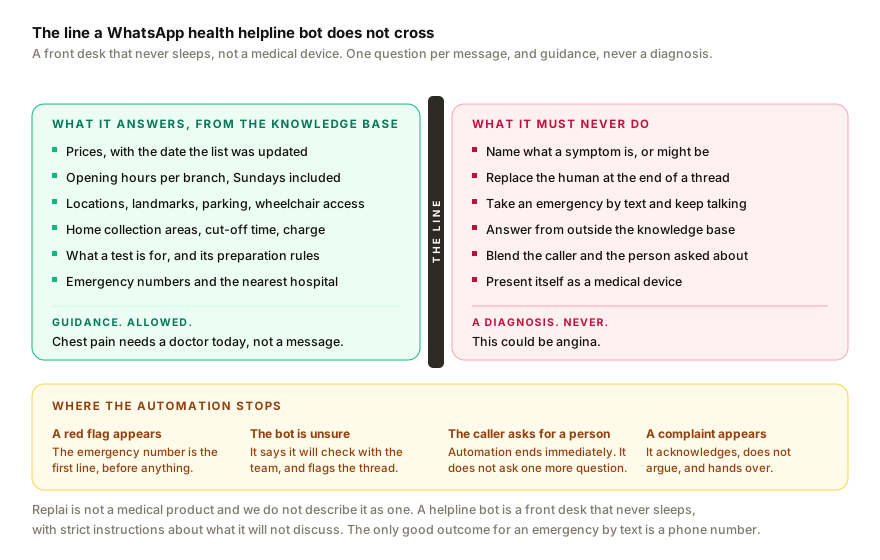
Never claim a diagnosis. The bot can say a symptom is worth seeing a doctor about today. It cannot say what the symptom is. "This could be angina" is a diagnosis. "Chest pain needs a doctor today, not a message" is guidance.
Surface emergency numbers the moment a red flag appears. Before any question, before any disclaimer. The first line of the reply is the number to call, such as 112 in India or 999 in Malaysia, and the nearest emergency department from the knowledge base. Only then, if at all, one short question.
Always point to a doctor. Every symptom conversation ends the same way: a doctor, a clinic, an appointment. The bot's job is to get the caller to the right human faster, not to replace the human.
Keep separate histories for the caller and the person they ask about. Many helpline messages are on behalf of someone else: a parent, a child, a neighbour. If the caller says "I'm 34" and later "she is 71", the bot must not blend those into one patient. Tell it to confirm who the details belong to and to restate that when it summarises: "for your mother, 71, with the swelling since Tuesday". A message next week about their son is a new subject, not a continuation.
First contact: three short messages, not one long one
The first reply to a new number sets the tone. Send it as separate short messages, not a wall.
The first is a disclaimer and a privacy line in plain words: this is an information helpline, not a doctor; in an emergency call 112; what you write here is read by our staff and kept private.
The second is a language choice. For a helpline in Maharashtra that might be English, Hindi, Marathi or Urdu. Let the caller reply with a word or a number. After that the bot should follow whatever language the caller actually writes in, message by message, because people switch mid-conversation and a voice note in Marathi should get a Marathi reply.
The third is the open question: how can we help today?
Three bubbles, each under 40 words. The caller reads all three. A single 150-word opener gets skimmed, and the disclaimer is the part they skip.
What the knowledge base should hold
The bot answers only from what you give it. If the answer isn't there it should say it will check with the team and flag the thread, not guess. So the knowledge base is the product. For a health helpline it needs:
| Section | What goes in it |
|---|---|
| Services | Each test or service, what it's for in one line, fasting or preparation rules |
| Opening hours | Per branch, including Sundays and public holidays |
| Locations | Address, landmark, map link, parking, wheelchair access |
| Test prices | Current list with the date it was updated |
| Home collection | Areas covered, cut-off time, extra charge, who can book |
| Emergency numbers | National number, ambulance, nearest 24-hour hospital per branch |
| Escalation contacts | Which person or number takes over, and when |
Two habits matter. Date every price list, because a stale price answered confidently is worse than no answer. And write escalation contacts as rules the bot can follow ("for any complaint, say the manager will reply within an hour and flag the thread"), not as a phone directory.
When should a human take over from a triage bot?
The bot needs three explicit handover triggers, and the team needs to know they will fire.
- The bot is unsure. The question is off the knowledge base or fits no pattern it was given. It says it will check with the team, and the thread lands in front of a person.
- The caller asks for a person. "Can I talk to someone" ends the automation immediately. No "are you sure", no one more question.
- A complaint appears. A wrong report, a rude phlebotomist, a missed home collection. The bot acknowledges, doesn't argue, and hands over.
Handover only works if someone is watching. Decide who reads flagged threads by day, who gets the escalation email at night, and what the caller is told about timing. "Someone will reply by 9am" is a promise you can keep. "Someone will reply shortly" at 11pm is not.
Honest limits
A WhatsApp bot is not a medical device and must not present itself as one. It is a front desk that never sleeps, with strict instructions about what it will not discuss.
It is not for emergencies. Say so on the poster, in the first message and in the bot's own replies. The only good outcome for an emergency sent by text is a fast redirect to a phone number.
Keep the logs private. Limit who on your team can open the dashboard, don't export transcripts into shared folders, and don't log anything to a spreadsheet the caller didn't need you to store.
Keep a backup number. Any tool that pairs to WhatsApp as a linked device, ours included, runs on an unofficial library and carries ban risk. For a helpline that's a continuity question, not a marketing one. Print two numbers, keep the second one alive with real inbound traffic, and keep your knowledge base where you can re-pair in an afternoon. We've written about what actually gets numbers banned; read it before launch, not after.
Where Replai fits
We didn't build Replai as a medical product and we won't describe it as one. What it gives a helpline is the plumbing around the pattern above.
- A template to start from. Begin with the clinics template, then put the safety rules above everything else in the prompt: the red-flag list, the emergency numbers, the three-message first contact, the no-diagnosis rule.
- Knowledge base grounding. Prices, branches, home-collection rules and hours go in as text or PDFs. The bot answers from that and nothing else, and flags the thread when the answer isn't there.
- Flag review. A second AI reads every reply and surfaces complaints, scams and abuse on the dashboard, so the complaint trigger fires even when the caller never uses the word "complaint".
- Human takeover. Any thread can be taken over from the dashboard, and the bot pauses on that thread until you hand it back. Office hours and escalation emails cover the night shift.
- Language detection. Hindi, Marathi, Urdu or English, text or voice note, detected per message, so the caller's choice at first contact holds without anyone managing it. Voice notes are on the Growth plan and above.
The 7-day trial at replai.pm needs no card and includes ten conversations, enough to test the red-flag path with your own team before a caller ever sees it.
Related
- WhatsApp for NGOs and community helplines
- WhatsApp appointment booking for clinics in Malaysia
- How to write a system prompt for a WhatsApp customer service bot
- Setting up a multilingual WhatsApp chatbot
- Will WhatsApp ban your number? An honest answer
Frequently asked questions
Should a triage bot ever suggest what a symptom means?
- No. It can say that a symptom needs a doctor today, which is guidance, but it cannot say what the symptom is, which is a diagnosis. The difference shows in the wording: chest pain needs a doctor today, not a message, is safe; this could be angina is not. Put that rule above everything else in the instructions.
How should a bot handle a message about someone else?
- Keep separate histories for the caller and the person they are asking about. Many helpline messages are on behalf of a parent, a child or a neighbour, so the bot should confirm whose details it has and restate them when it summarises. A message next week about a different relative starts a new subject, not a continuation.
Can a WhatsApp bot handle voice notes on a helpline?
- Yes, and it should, because worried callers often record rather than type. The voice note is transcribed, read like any other message and answered in the language it was spoken in, so the caller is not asked to switch. Voice note handling is a Growth plan feature on Replai rather than a Starter one.
What should a helpline do about the risk of losing the number?
- Treat it as a continuity question. Any tool that pairs as a linked device runs on an unofficial connection, so print two numbers on your posters, keep the second one alive with real inbound traffic, and store the knowledge base where you can re-pair in an afternoon. Read the ban guidance before launch, not after.
Sources
- Making voice messages better, WhatsApp, 2022-03-30
- About WhatsApp, WhatsApp, 2026-09-08
Keep reading
Article
WhatsApp chatbot for clinics: handle appointment requests and fee questions without giving medical advice
Article
WhatsApp chatbot for tuition centres: answer every parent enquiry without touching your existing chats
Article
WhatsApp chatbot for Shopify stores: what actually works in 2026
Tutorial
How to connect your WhatsApp number to Replai
See it answer your own customers.
Pair your number, paste in what you know, and message it from another phone. Ten minutes, no card.