Quick answer
A clinic chatbot answers fees, opening hours, panels and insurers, location and parking, and what to bring, all from the clinic's own documents, then logs appointment requests to a sheet for the front desk to confirm. It must not diagnose, name a condition or suggest a dose: symptoms, results and dosage go to a person every time.
- The bot answers fees, hours, panels and logistics; symptoms and results go to a person.
- Five documents are enough: fees, schedule, panels, logistics and procedure explainers.
- Pair on new conversations only so existing patient threads stay with the front desk.
- Test with a clinical question first: the right answer is a hand-off, not a paragraph.
A clinic's WhatsApp is a queue of the same eight questions, asked while the front desk is on the phone or with a patient: is there a slot tomorrow, how much is a scaling, do you take my panel, where do I park, is the doctor in on Saturday. A WhatsApp chatbot answers those from your own fee list and schedule, in the patient's language, collects appointment requests for staff to confirm, and hands anything clinical to a human. Set up correctly, it never gives medical advice and never touches the patient conversations already on the phone.
This is the setup we recommend for GP, dental, aesthetic, physio and specialist clinics.
Where the line is
Everything on the first list is worth automating because of when patients ask. The Lead Response Management Study run with MIT found that answering an enquiry within five minutes rather than thirty makes contact about 100 times more likely, and that the odds of reaching someone fall more than ten times inside the first hour (InsideSales.com and MIT, 2007). A patient comparing three clinics at 9pm is on exactly that clock.
Decide this before anything else, because it shapes the knowledge base and the prompt.
The bot handles: fees and packages, opening hours and public holidays, location, parking and transport, which panels and insurers you accept, what to bring, what a first visit or a named procedure involves in general terms as you describe it, appointment requests, and reminders.
The bot hands to a person: anything about symptoms, results, dosage, interactions, whether a treatment is suitable for a specific patient, emergencies, complaints, and any request to change or cancel an existing appointment that a human should verify.
The system prompt says this explicitly and the bot says "let me get a member of the team to answer that" rather than improvising. If you evaluate another tool, ask to see how it behaves on "is it normal that my gum still bleeds two days after the extraction". The right answer is a hand-off, not a paragraph.
What should a clinic chatbot know before it answers patients?
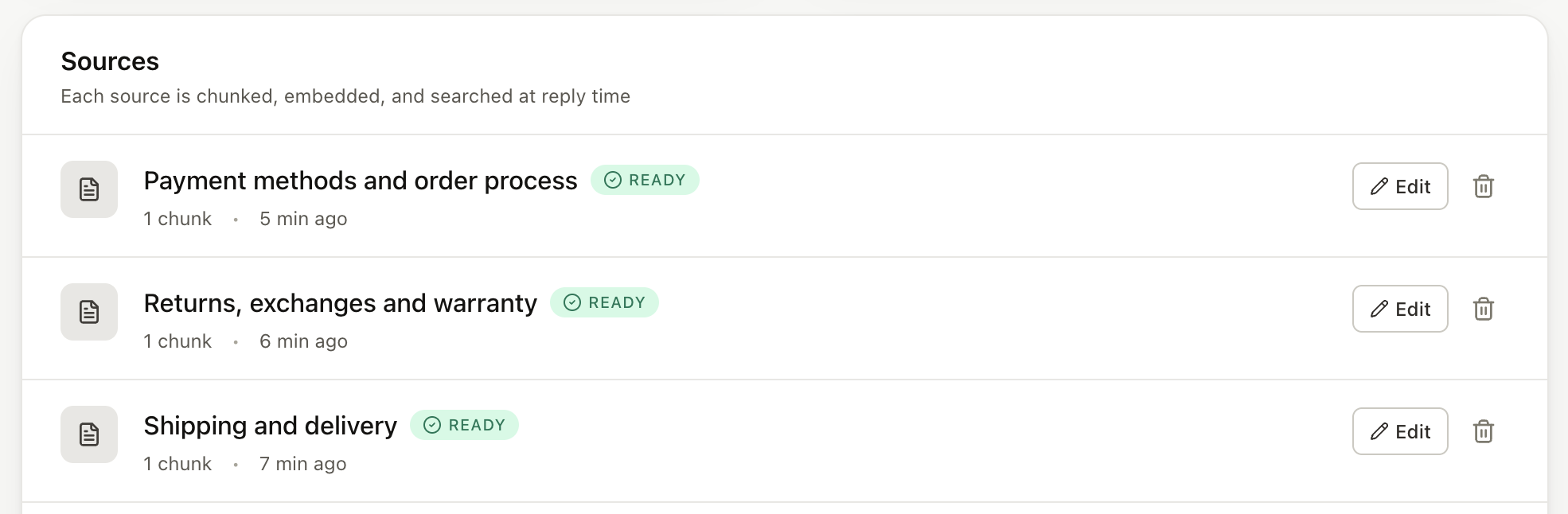
Five documents, pasted as text or uploaded as PDF:
- Fees: consultation, common procedures and packages, what is included, deposit and cancellation rules. If prices depend on assessment, say so and give a range.
- Schedule: opening hours per day, which doctors or therapists are in on which days, public holiday closures, and how far ahead you book.
- Panels and payment: insurers and corporate panels accepted, what the patient needs to bring for a panel visit, payment methods.
- Logistics: address with landmark, parking, nearest transport, wheelchair access, what to bring for a first visit.
- Procedure explainers: two or three plain paragraphs per common procedure describing what happens at the visit and how long it takes, written by the clinic. The bot quotes these; it does not add to them.
Leave out patient records, staff numbers, and anything you would not want repeated to a stranger.
Keeping it out of existing patient chats
A clinic's number carries months of live conversations: follow-ups, results discussions, staff. A bot that answers all of them on day one is worse than no bot, and it is the most common reason clinics switch one off within an hour.
Replai's default for a newly paired number is new conversations only. Every thread that existed before pairing stays with the front desk; only patients who message for the first time get the AI. Later you can release a specific thread to the bot, for example a patient asking about next year's package, without opening the rest. The connect screen shows which mode you are in before you scan.
Language
Patients in Malaysia, Singapore and the Gulf write in more than one language, often within one message, and many send voice notes. The bot should follow the patient's language message by message rather than asking them to choose. Replai auto-detects per message, voice notes included; our multilingual setup guide covers how to test it.
What does the first week with a clinic chatbot look like?
- Day 1. Pair a dedicated clinic number, load the five documents, leave the bot on new conversations only, and test with the ten questions the front desk answered most last week. Include two clinical ones to confirm they are handed off.
- Day 2 to 3. Let it answer new enquiries. Read every conversation each morning. If it hands off too often, a document is missing something; if it ever answers a clinical question, tighten the prompt before anything else.
- Day 4 to 7. Turn on lead capture so appointment requests land in a Google Sheet with service, preferred time, panel and contact. The front desk confirms from the sheet.
- After week one. Decide whether any existing patient threads should go to the bot. Most clinics keep it on new-only.
What it costs
On Replai the Starter plan is $19 a month for one number and 120 conversations a cycle, where a conversation is one patient thread of up to five bot replies. Growth is $49 for up to three numbers, 300 conversations and outbound reminders, which suits a clinic with two branches. The AI is included, there are no per-message fees because it pairs to the number you already have, and top-ups are 100 conversations for $9 on Starter, $8 on Growth or $7 on Pro. The 7-day trial needs no card.
Worked examples for specific clinic types: clinics in Malaysia, dental clinics, and pharmacies and medical supply stores. For a helpline rather than a clinic, see running a health helpline on WhatsApp.
Related
- WhatsApp appointment booking for clinics in Malaysia (use case)
- WhatsApp chatbot for tuition centres
- WhatsApp chatbot without the Business API: how QR pairing works
Frequently asked questions
Can a WhatsApp chatbot book clinic appointments?
- It can handle the request: which service, preferred day and time, whether the patient is new, panel or insurance, and the patient's name and number, then log it to a Google Sheet or your booking link for the front desk to confirm. Committing a slot without a human is the wrong line for a clinic, so the bot stops short of that.
Will a clinic chatbot give medical advice?
- It must not, and a properly configured one does not. The system prompt restricts it to fees, hours, panels, locations, what to bring and what to expect at a visit, all from the clinic's own material, and hands any question about symptoms, dosage, results or diagnosis to a person. Everything outside the knowledge base is handed off, not guessed.
Will the bot reply to patients who were already messaging the clinic?
- Not on Replai's default setting. New accounts answer new conversations only: threads that existed on the phone when you paired stay with your staff, and only patients who message for the first time get the AI. You can release one old thread to it when you choose.
Can it answer patients in Bahasa Malaysia, Mandarin, Tamil and English?
- Yes, and it follows the patient's language message by message, including voice notes. A patient who opens in English and switches to Mandarin gets replies that switch with them. No language menu is needed.
How much does a WhatsApp chatbot cost for a clinic?
- On Replai, $19 a month for one number and 120 conversations a cycle, or $49 for up to three numbers and 300 conversations, useful for a clinic with two branches. The AI is included, there are no per-message fees because it pairs to the number you already have, and the 7-day trial needs no card.
Sources
- Lead Response Management Study, InsideSales.com and MIT, James Oldroyd, 2007
- The Short Life of Online Sales Leads, Harvard Business Review, 2011-03
Keep reading
See it answer your own customers.
Pair your number, paste in what you know, and message it from another phone. Ten minutes, no card.