Quick answer
Add the Abandoned cart status under Orders, Messages. It sends after a set number of minutes without an order, with a %cart_link% that rebuilds the basket on any device. Carts are captured by the WooCommerce plugin as soon as a phone number is typed at checkout. Pending payment does the same job for orders that were placed but never paid.
- A cart is only captured once the customer typed a phone number at checkout.
- Sixty minutes is a sensible default. Ten feels like surveillance.
- %cart_link% rebuilds the basket on any device, which is what makes this convert.
- One reminder, maybe two. A third is where recovery turns into nuisance.
About 15 minutes
Before you start
- WooCommerce connected with the Replai plugin, for carts
- Any store connection, for unpaid orders
These are two recoveries that get discussed as one thing and should not be. The customer is in a different place in each, and a message written for one lands badly in the other.
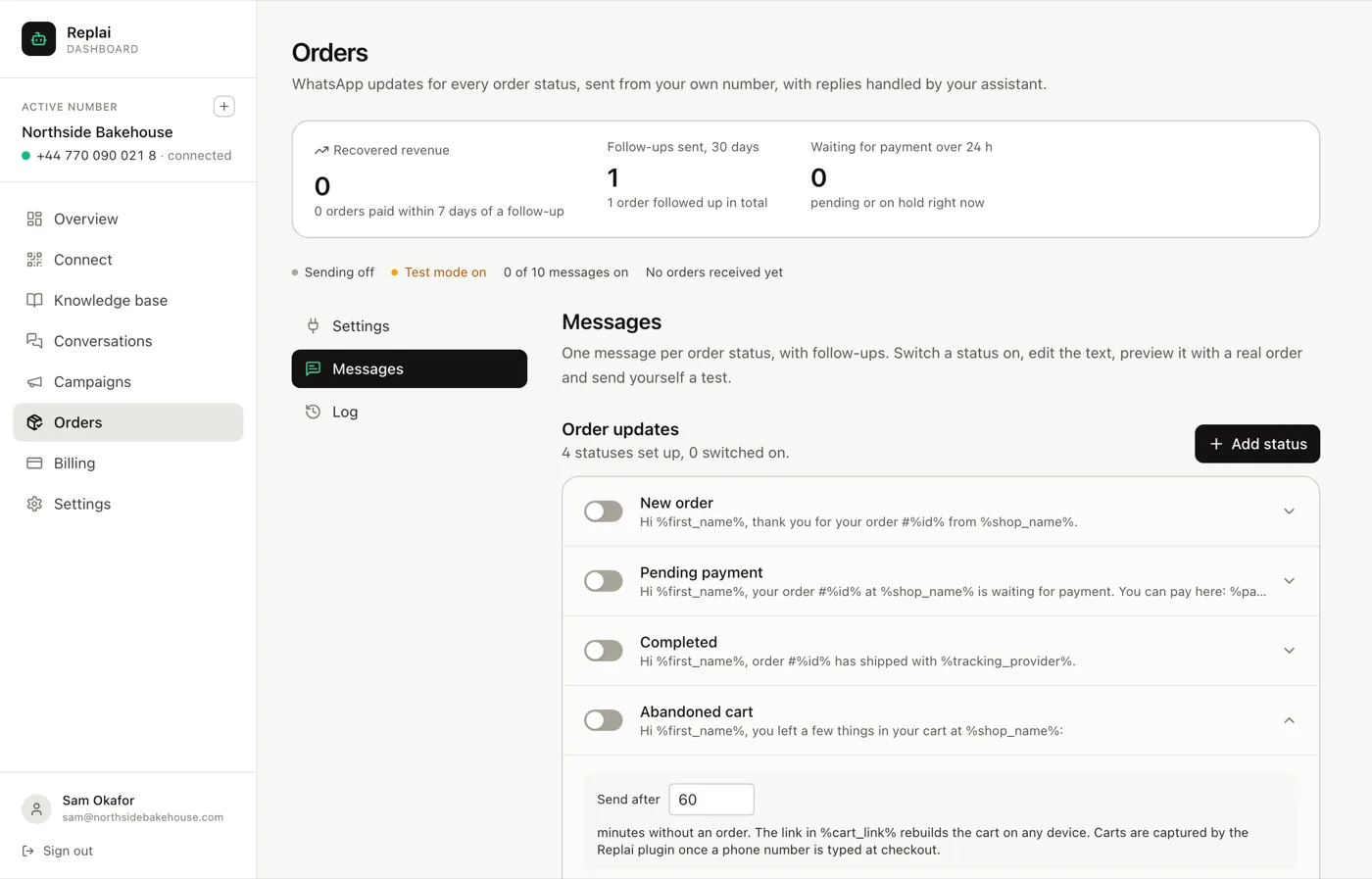
Abandoned cart: a checkout that never finished
Somebody filled a basket, started checking out and stopped.
When the cart is captured is the part worth understanding, because it sets a ceiling on everything else. The Replai plugin captures a cart as soon as the customer types a phone number at checkout. Before that there is no way to reach them.
That makes your checkout layout, not your message, the biggest lever on recovery volume. A phone field near the end of a long checkout captures a fraction of the carts that a phone field near the start would.
The delay
Sixty minutes is a good default.
Ten minutes is the mistake people make. The customer may still be in the next tab comparing prices, and a message that lands mid-decision reads as being watched rather than helped. The gap between helpful and creepy here is measured in minutes and there is no undo.
Longer than a few hours and the intent has usually gone cold.
The message
The recovery message has one job and one asset. The asset is %cart_link%, which
rebuilds the basket on any device. That matters more than the wording: most
abandoned carts happen on a phone in a queue somewhere, and the person who comes
back is often on a laptop hours later.
Hi %first_name%, you left a few things in your cart at %shop_name%. Everything is still there if you want it: %cart_link%
Reply here if something was unclear, or if you want to change the order.
Three things that make it work: it is short, the link is a single tap, and the second line invites a reply. That last line is the one most people leave out, and it is where the real value is. A cart is often abandoned because of a question, usually about delivery cost or timing, and a customer who answers that question in a reply gets it answered by the bot immediately.
No discount in the first message. Discounting a cart the customer might have completed anyway trains people to abandon on purpose. Save it for a second message, if you send one.
How many
One. Two if the second is a day later and says something new.
The third converts almost nobody and produces exactly the blocks and reports that damage a number on an unofficial connection. Cart recovery is a nudge, and there is a line past which a nudge is just pestering.
Pending payment: an order that exists and is not paid
Different situation entirely. The customer decided. Something else went wrong, or nothing went wrong yet and the transfer is still coming.
This is a real problem for anyone taking bank transfer or cash on delivery, where an order can sit unpaid for days while stock is reserved against it.
The tone is different too, because you are asking for money rather than reminding someone of something they wanted:
Hi %first_name%, order #%id% at %shop_name% is waiting for payment, %order_total%.
You can pay here: %payment_link%
Reply if you would rather pay another way, or if you want to cancel it.
Offering the cancel is not weakness. An order that is never going to be paid is worth clearing out of your stock reservation early, and saying so gets you an honest answer instead of silence.
Measuring whether it works
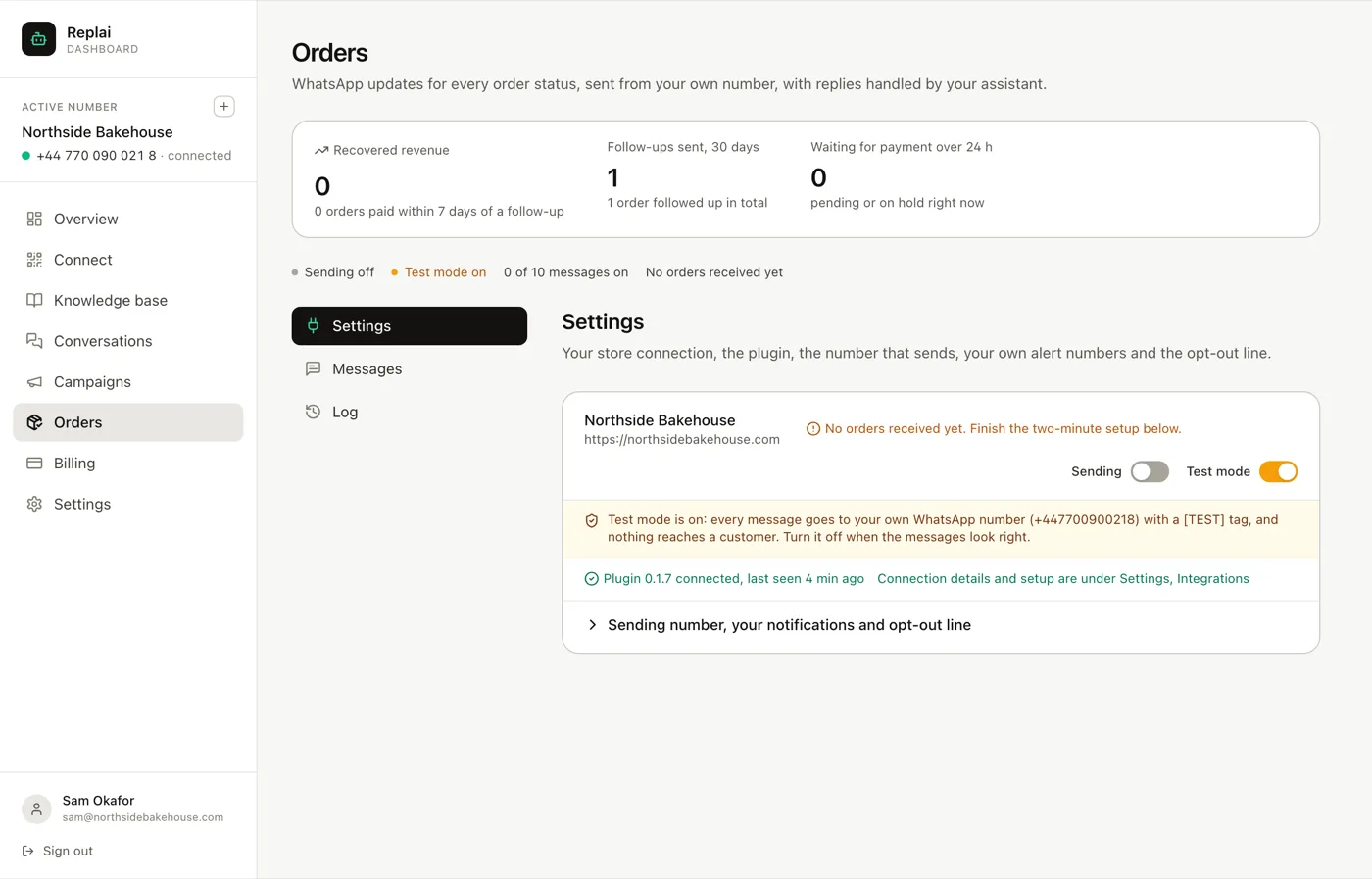
The recovered revenue counter on the Orders page counts orders paid within seven days of a follow-up going out. That attribution window is deliberately conservative: it is easy to build a number that credits recovery for every order that was always going to happen, and that number tells you nothing.
Watch it alongside opt-outs. Recovery that works shows up as revenue with flat opt-outs. Recovery that is annoying people shows up as both rising, and the second one costs more than the first one earns.
What to do next
If you have several shops or brands on one account, the next guide covers running more than one WhatsApp number from the same workspace.
Frequently asked questions
When is a cart actually captured?
- As soon as the customer types a phone number at checkout. Before that there is nobody to message, which is why cart recovery rates depend heavily on where the phone field sits in your checkout. A phone field at the end captures far fewer carts than one near the start.
How long should I wait before sending?
- Sixty minutes is a good default. Ten minutes reads as surveillance, because the customer may still be in the next tab comparing prices, and a message that arrives while they are still shopping feels like being watched rather than helped.
How many reminders?
- One, or two at most, with the second a day later. The third message converts almost nobody and produces the blocks and reports that damage a number. Recovery is a nudge, and past a certain point a nudge is just pestering.
What is the difference between abandoned cart and pending payment?
- An abandoned cart is a checkout that never became an order. A pending payment is an order that exists and has not been paid, which is common with bank transfer and cash on delivery. Different situations, different messages: one is a reminder of something they wanted, the other is a request for money.
Does this work on Shopify?
- Abandoned cart capture is a WooCommerce plugin feature, because the plugin sees a checkout that was started and never finished. Pending payment follow-ups work on any connected store, because an unpaid order is a real order the store already knows about.
Keep reading
See it answer your own customers.
Pair your number, paste in what you know, and message it from another phone. Ten minutes, no card.