Quick answer
A Click-to-WhatsApp ad finishes its job when the opener lands in your inbox; everything after that is yours. Reply within seconds in the language the message arrived in, ask which product was tapped, give the price from your knowledge base, then ask for a name and number. Measure qualified leads per 100 chats rather than taps.
- The opener carries a phone number and one sentence, rarely the product the customer tapped.
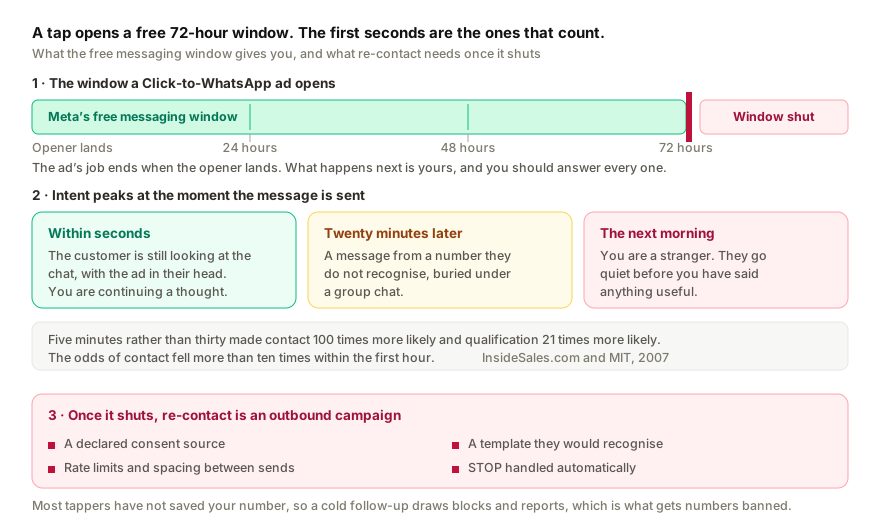
- Meta gives a free 72-hour messaging window after a click-to-WhatsApp ad.
- Track qualified leads per 100 chats and cost per qualified lead, not tap volume.
- Never blast ad tappers a week later; treat re-contact as a consented outbound campaign.
A Click-to-WhatsApp ad is the lowest-friction ad you can run. Nobody lands on a page, nobody fills in a form. The button opens a chat with your number, the first message is already typed, and all the customer does is tap Send.
That is exactly the problem. Tapping is so cheap that a campaign with a decent creative fills your inbox with dozens of identical openers, many from people scrolling in bed who won't remember your brand tomorrow. The ad has done its part. Whether any of those chats become customers depends on what happens in the first few seconds after the message lands, and that part is yours.
How do Click-to-WhatsApp ads work?
You build the ad in Meta's Ads Manager like any other Facebook or Instagram ad, but the call to action is a WhatsApp button pointed at the number you've connected to your Page. When someone taps it, their WhatsApp opens on a chat with you, with an opener already filled in. Meta's default reads roughly "Hello! Can I get more info on this?", and it appears in the language of the customer's phone, so a Malaysian audience sends you the same sentence in English, Bahasa and Mandarin. You can replace the default with your own wording per ad.
Two things to notice. First, the ad's job ends when that message arrives. From there it's an ordinary chat on your number: no form data, no email address, just a phone number and one sentence. Second, the opener usually doesn't say which product they tapped. Sometimes the ad thumbnail travels with the message; don't count on it. Either write a different opener for each ad ("Hi, I'm interested in the linen set") or make sure your first reply asks.
Why most openers are low-intent, and why seconds matter
Intent is hard to measure, but response time is not. In the InsideSales.com and MIT lead response study, contacting a web lead within five minutes rather than thirty made contact 100 times more likely and qualification 21 times more likely, and the odds of making contact fell more than ten times within the first hour (Oldroyd, MIT, 2007). Those were phone calls to web forms, but the shape holds on WhatsApp, where the customer is still holding the phone.
A tap costs the customer nothing. No typing, no thinking. So a large share of openers come from people who wanted to see what would happen, or who liked the photo and had a vague question. That isn't a flaw in the ad; it's what a zero-friction button produces.
Intent peaks at the moment the message is sent. The person is looking at the chat, with the ad still in their head. Reply within seconds and you're continuing a thought. Reply in twenty minutes and you're a message from a number they don't recognise, buried under a group chat. Reply the next morning and you're a stranger.
The first reply doesn't need to sell. It needs to keep the thread alive: one acknowledgement and one question, so the customer does the smallest possible next thing.
We're deliberately not quoting a platform-wide figure for what share of openers turn into buyers, because we don't have one we trust, and you should be suspicious of anyone who does. Your own share is the one that matters, and you'll know it within a week if you count (more on that below).
What to prepare before the ad goes live
Most owners launch first and build the answers later, after the first hundred people have asked. Do it in this order instead.
- A knowledge base that covers what the ad promises. For every product in the creative: price, sizes or variants, what's in stock, delivery cost and time by area (RM 8 West Malaysia, RM 15 East Malaysia, 2 to 4 working days, whatever yours are), payment methods (bank transfer, DuitNow QR, cash on delivery, card link), and returns. If the ad says "from RM 59", the knowledge base must say what RM 59 buys.
- A language plan. Your targeting decides which languages arrive. Decide the rule up front: reply in the customer's language, per message, and match mixed-language messages with a mixed reply. See our multilingual setup guide for the details.
- Voice-note handling. A share of the replies to your first question will be voice notes, especially from older customers. Decide whether they get transcribed and answered or parked for a human, and tell the human.
- One lead-capture question. Decide the single piece of information that turns a chat into something you can follow up: for most stores, a name and the best number. Ask it once, after the price, never before.
- Capacity. Know how many chats you can answer in the campaign's first hour. If your bot bills per conversation, check how much headroom is left in the cycle before you launch; a good weekend campaign can use a month's worth.
A reply flow that turns taps into leads
This is the flow we've settled on. Each step is one short message.
- Acknowledge within seconds, in the customer's language. One line, no pitch.
- Ask which product they tapped on, unless the opener already says. One question only.
- Give the price and the one detail that usually matters (sizes, delivery), straight from the knowledge base. Never "please check our website"; they came from a website.
- Ask for a name and the best number to reach them on. They're already on WhatsApp, so it's usually the same number, but asking confirms there's a real person who wants a follow-up, and it gives you a record you own outside the app.
- Log it to Google Sheets: time, number, product, language, and a status column.
- Hand hot leads to a human. Anyone who asks how to pay, asks about stock for a specific size, or sends a receipt photo is past triage. The flow's job is sorting, not closing.
A first reply that does steps one and two together looks like this:
Hi, thanks for messaging us. Which one caught your eye, the linen set or the batik shirt? I can give you the price and delivery time straight away.
How do you measure a Click-to-WhatsApp campaign?
| Metric | Count | Tells you |
|---|---|---|
| Qualified leads per 100 chats | Chats with name, number and product, per 100 openers | The reply flow works |
| Cost per qualified lead | Ad spend divided by qualified leads | The number to compare ad sets on |
| Chats that got a price | Chats with a price sent, per 100 openers | The knowledge base covers the ad's promise |
Watch where people go quiet, too. If they vanish after the price, the ad and the price don't match. If they vanish before you've said anything useful, the problem is reply speed or language.
Ban-safety when the volume spikes
A sudden jump in inbound chats, each answered promptly, is the pattern WhatsApp expects from a business that's running an ad. Replying to people who messaged you first is the low-risk side of WhatsApp, and you should answer every one of them.
What isn't low-risk is what owners do next: exporting everyone who tapped and sending a follow-up blast a week later. Those contacts sent you one sentence. Most haven't saved your number, and the ones who've forgotten you will block or report, which is what gets numbers banned. If you want to re-contact tappers, treat them as an outbound campaign: a declared consent source, a template they'd recognise, rate limits and spacing, and STOP handled automatically. Our guide to broadcast limits covers the numbers.
Two more cautions. Point the ad at a number with real chat history rather than a SIM you bought last week; an established number is a better place to receive a flood. And no tool can promise you'll never be banned, so read what to do if it happens before it does.
Where Replai fits
Replai pairs to the same number the ad points at, as a linked device, so there's nothing to migrate and no API application. It answers each opener within seconds in whatever language it arrived in, from the knowledge base you gave it. If a price isn't in there, it says it'll check with the team and flags the thread instead of making one up. It transcribes voice notes and reads product screenshots (on Growth and above), asks for a name and number naturally, logs the lead to Google Sheets, and quietly flags complaints and scam attempts so a human sees those first.
It runs on an unofficial WhatsApp library, like every tool that works with your existing number, so the ban risk above applies to us too. And it doesn't give you the green verified badge or Meta-approved templates. If your campaign depends on those, the official API is the better fit.
If you're launching a campaign this month, set the answers up before the ad goes live rather than after the first hundred openers. The 7-day free trial needs no card and takes a few minutes to pair.
Related
- Will WhatsApp ban your number? An honest answer
- WhatsApp broadcast limits per hour and per day
- WhatsApp conversation pricing explained
- How to write a system prompt for a WhatsApp customer service bot
- WhatsApp chatbot for e-commerce stores
Frequently asked questions
How fast should you reply to a Click-to-WhatsApp ad opener?
- Within seconds, while the customer is still looking at the chat. Lead response research is blunt about the decay: contacting a web lead within five minutes rather than thirty makes contact 100 times more likely, and the odds of reaching someone fall more than ten times within the first hour. Instant replies keep the thread alive.
Why are Click-to-WhatsApp leads such low intent?
- Because tapping costs nothing. There is no form, no email address and no typing, so a large share of openers are curious rather than ready to buy. That is what a zero-friction button produces, not a fault in the creative. The answer is a first reply that asks one question, then counting qualified leads per 100 chats.
Does the opener say which product the customer tapped?
- Usually not. The default opener is a generic line that appears in the language of the customer's phone, and the ad thumbnail does not always travel with the message. Either write a different opener for each ad, naming the product in the text, or make your first reply ask which item they saw.
Can you message ad tappers again a week later?
- Only as a proper outbound campaign. Those contacts sent one sentence and most have not saved your number, so a cold follow-up draws blocks and reports, which is what gets numbers restricted. Use a declared consent source, a template they will recognise, rate limits, spacing between sends, and automatic STOP handling.
Sources
- Lead Response Management Study, InsideSales.com and MIT, 2007-01-01
- The Short Life of Online Sales Leads, Harvard Business Review, 2011-03-01
- WhatsApp Business Platform pricing, Meta for Developers, 2025-07-01
Keep reading
Article
WhatsApp auto-reply bot for small businesses: the three kinds, what they cost, and how to set one up
Article
WhatsApp customer service in Arabic and French: handling Darija voice notes with AI
Article
Use ChatGPT to write your WhatsApp bot's rules, then paste them in
Tutorial
How to connect Google Sheets for leads and order lookup
See it answer your own customers.
Pair your number, paste in what you know, and message it from another phone. Ten minutes, no card.